


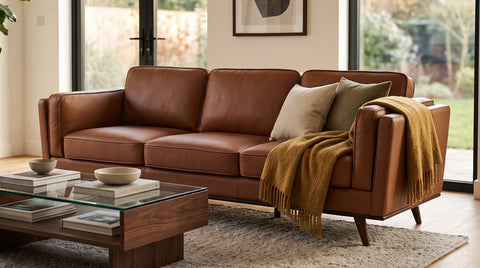
When shopping for a leather sofa, you'll often come across two terms: top grain leather and full grain leather.
Both are associated with high-quality furniture, but what's the difference? Is full grain leather always better? And does top grain leather offer better value for everyday use?
The answer depends on your lifestyle, design preferences, and how you want your sofa to age.
In this guide, we'll explore the differences between top grain and full grain leather, including durability, comfort, maintenance, appearance, and price, so you can make a confident decision for your home.
What Is Full Grain Leather?
Full grain leather comes from the outer portion of an animal hide and retains its original grain surface without sanding or buffing to remove imperfections.
Because the natural grain remains intact, full grain leather often displays unique characteristics, including subtle wrinkles, natural pores, and variations in texture.
These characteristics aren't necessarily defects. They're part of what makes natural leather distinctive.
Benefits of full grain leather:
-
Retains the hide's original grain surface.
-
Preserves natural markings and variations.
-
Offers excellent durability when properly produced and maintained.
-
Can develop a beautiful patina over time, depending on the finish.
-
Creates a distinctive, natural appearance.
Full grain leather is an excellent choice for homeowners who appreciate natural materials and enjoy furniture that develops character with age.
However, the more natural the finish, the more visible scratches, stains, and everyday marks may become.
What Is Top Grain Leather?
Top grain leather also comes from the upper portion of the animal hide.
Technically, full grain leather is itself a type of top grain leather. However, in the furniture industry, top grain is frequently used to describe leather that has undergone some surface correction to create a more consistent appearance.
This may involve light buffing, finishing, or other treatments, depending on the manufacturer.
The result can be leather with a smoother, more uniform appearance while maintaining the strength and flexibility associated with the grain-bearing portion of the hide.
Benefits of top grain leather:
-
Made from the strong upper portion of the hide.
-
Offers excellent comfort and durability.
-
Can provide a smoother, more consistent appearance.
-
Available in various textures, colours, and finishes.
-
Certain protective finishes make routine cleaning easier.
-
Often offers an appealing balance of quality and value.
For many households, a well-made top grain leather sofa is a practical option that combines comfort, style, and long-term usability.
Top Grain vs Full Grain Leather: Key Differences
| Feature | Full Grain Leather | Top Grain Leather (Surface-Corrected) |
|---|---|---|
| Hide origin | Upper portion | Upper portion |
| Surface | Original grain intact | May be buffed or corrected |
| Appearance | Natural variations | Generally more uniform |
| Durability | Excellent | Excellent |
| Softness | Depends on tanning and finish | Depends on tanning and finish |
| Patina | Often pronounced with natural finishes | Varies by finish |
| Maintenance | May require more care | Protective finishes can simplify care |
| Price | Often higher | Often more affordable |
Both materials can provide years of comfortable use when properly manufactured and maintained.
The important thing to remember is that leather quality depends on more than just its classification. The tanning process, leather thickness, surface finish, craftsmanship, and sofa construction also play important roles.
Which Leather Is More Durable?
Durability is one of the biggest considerations when buying a leather sofa.
Full grain leather preserves the hide's natural surface and can be exceptionally durable. Its intact grain and natural appearance make it especially appealing to people who appreciate how leather changes over time.
Top grain leather also uses the strong upper portion of the hide and can offer excellent long-term performance.
When top grain leather has a protective finish, it may provide greater resistance to certain everyday stains and surface marks.
However, this doesn't automatically make every top grain sofa more durable than every full grain sofa.
The better question is: How was the leather made and finished?
A carefully manufactured top grain leather sofa may outperform a poorly finished full grain leather sofa in everyday conditions.
For families with children or pets, choosing an appropriate finish can be just as important as choosing the grain type.
Which Leather Is Softer and More Comfortable?
There's a common misconception that full grain leather is always thicker and stiffer, while top grain leather is always softer.
In reality, softness depends heavily on how the leather has been tanned, processed, and finished.
Both full grain and top grain leather can be remarkably supple.
For example, aniline and semi-aniline leathers are often chosen for their natural appearance and comfortable feel.
Aniline leather typically has minimal protective surface coating, allowing more of the leather's natural character to remain visible.
Semi-aniline leather generally includes a light protective finish, offering a balance between natural appearance and everyday practicality.
When choosing a sofa, don't rely on the term "full grain" or "top grain" alone to determine comfort.
Instead, consider the leather finish, seat cushioning, support, and overall sofa design.
Which Leather Is Better for Homes With Kids and Pets?
If you have children or pets, leather can be an excellent upholstery choice.
Compared with many woven fabrics, leather doesn't trap pet hair within fabric fibres, and its smooth surface can make routine cleaning relatively simple.
However, no natural leather is completely scratch-proof.
Full grain leather with a natural, lightly protected finish may show scratches and marks more easily. Some homeowners enjoy this lived-in character, especially on distressed leather furniture.
Top grain leather with an appropriate protective finish may be better suited to households that prioritize easier cleaning and a more consistent appearance.
For busy households, consider:
-
The amount of protective finish on the leather.
-
How visible scratches will be on the selected colour.
-
Whether you prefer a natural patina or a uniform appearance.
-
The manufacturer's cleaning and maintenance recommendations.
If you're choosing a leather sofa for a family living room, the finish deserves just as much attention as the grain.
Does Full Grain Leather Last Longer Than Top Grain Leather?
Not necessarily.
Both full grain and top grain leather can remain in excellent condition for many years with proper care.
A sofa's lifespan also depends on factors beyond the upholstery, including frame construction, suspension, cushion quality, frequency of use, and maintenance.
Even the finest leather won't compensate for a poorly constructed sofa.
That's why it's important to evaluate the furniture as a complete product rather than focusing on one material description.
A well-constructed sofa with quality top grain leather can be a better long-term investment than a poorly constructed sofa advertised as full grain leather.
Top Grain vs Full Grain Leather: Which Is More Expensive?
Full grain leather is often more expensive because hides with attractive, intact natural surfaces are highly valued, particularly for finishes that expose the natural grain.
Top grain leather with surface correction can often be produced with a more consistent appearance and may come at a lower cost.
However, prices vary significantly depending on the tannery, leather quality, finish, manufacturing process, and furniture construction.
A high-quality top grain leather sofa can cost more than a lower-quality full grain leather sofa.
Rather than comparing prices based on the leather name alone, evaluate the complete product and its specifications.
Why Leather Coverage Matters Just as Much as Leather Quality
Here's something many furniture shoppers overlook.
A sofa may be advertised as a "top grain leather sofa" even when different materials are used on different parts of the furniture.
Some manufacturers use leather on the seating surfaces while incorporating synthetic or alternative materials on the sides and back.
This is why it's important to confirm exactly where the leather is used.
At Luxana Home, we emphasize genuine leather upholstery throughout our leather furniture, including the sides and back, rather than relying on leather-match construction.
Understanding what covers the entire sofa helps you compare furniture more accurately and avoid surprises after purchasing.
Which Leather Should You Choose?
If you're deciding between top grain and full grain leather, start by considering what matters most to you.
Choose full grain leather if:
-
You appreciate the natural character of leather.
-
You enjoy visible grain variations and unique markings.
-
You want leather that can develop a distinctive patina.
-
You're comfortable with the care requirements of a natural finish.
Choose quality top grain leather if:
-
You prefer a smoother or more uniform appearance.
-
You want an excellent balance of comfort and durability.
-
You appreciate having a variety of finishes and colours.
-
You want leather that




Comments (0)
There are no comments for this article. Be the first one to leave a message!